Showing posts with label totem pole. Show all posts

Wednesday, July 04, 2012

Ketchikan, Alaska, part 2 June, 2012


Right after that I stopped at the Tongass Historical Museum which collects, preserves, and interprets material and information pertaining to the history, art, and culture of Ketchikan and Southeast Alaska.Check out its website at: 
     http://www.city.ketchikan.ak.us/departments/museums/tongass.html
 It is housed in the same building as the library.  The museum cost $2 and was easy to see in less than 30 minutes.
     Here are photos taken of Ketchikan around 1905:
Town on the waterfront
Ketchikan Business District, 1905

 Fishing was big in Ketchikan:
 Fish traps were used to catch fish.  Here is a photo taken in 1930 of large stationary ones. For hundreds of years before the Europeans came, the natives used traps on salmon streams, often driving stakes into the river bottom.  Late in the 1800s, canneries began to build stationary traps in the mouths of big streams, with pilings to support suspended nets.  The government later made that illegal as few of the salmon could escape so the traps were moved elsewhere.  They had to be repaired often so divers fixed them.
You can see the headgear the divers worse--this was before scuba diving became official

  Many local Alaskans hated the fish traps because they were owned by outsiders and depleted the salmon run for the locals.  In 1959, when Alaska became a state, it immediately banned such fish traps.
 
 Above is one of my favorite pictures, of local kids with a large halibut. The photo was taken in 1909.

Here is a cute sign from a cannery:
Here is another photo from the early 1900s with 3 little girls looking at a pet bear cub:
Here is a baby carriage quilt:
Telephone service began in Ketchikan in 1909.  This was a typical early phone and was used into the 1950s.

Casper Mather, a Tsimshian carver, made many small totem poles and masks from the 1930s to the 1970s.  The photo below was taken in the early 1950s.
The Truman pole on the right below was carved by Mather.  The middle one is a beaver, raven, bear pole and the far left one is a Haida Creation Myth pole made in 1962.
There was also a section on airplane service to Ketchikan. The picture of the float plane below was taken in the 1950s.

 The cashier gave me directions to the bus to Totem Bight and told me it was a lovely place, and that she had gotten married there.

So I walked back to town and took the Blue line bus out to Totem Bight, a state park with close to 20 totem poles preserved and moved to the site.  The bus is $1 one way (50 cents for seniors if you have correct change) or $2 for the day.  The guy I sat next to for part of the way out moved here 17 years ago.  He fishes in season and paints businesses inside and out at other times.  Sometimes the rains keep him for finishing jobs for days.  His father was from this area and mother originally part Native American from northern Mexico.  They met at Seattle College (now University) and settled in California.  He used to come up with his dad to this area to fish and the boys returned to live here.

This bus has just one driver for the day.  He leaves the port area and 45 min after the hour and leaves Totem Bight at 15 after the hour.  On the way back I sat next to a woman that moved here about 20 years ago too.  She is a cook for the loggers.   I said I didn’t think that there was much logging in the area and she agreed and it was because of the conservationists in Washington, Oregon, and Colorado, and said that because of the lack of logging there are fires in Colorado.  She was a kick, and was happy to take my bus pas for the rest of the day.  That bus stops at Walmart on the way out but not on the way back.  She said that in winter, the town is reduced to under 5000 people but I am not sure she is accurate. 

Here is the website for Totem Bight:   http://dnr.alaska.gov/parks/units/totembgh.htm

Walking into the park in the rain
With the growth of non-Native settlements in Southeast Alaska in the early 1900's, and the decline of a barter economy, Natives moved to communities where work was available. The villages and totem poles they left behind were soon overgrown by forests and eroded by weather. In 1938 the U.S. Forest Services began a program aimed at salvaging and reconstructing these large cedar monuments. By using Civilian Conservation Corps (CCC) funds to hire skilled carvers from among the older Natives, two things took place: young artisans learned the art of carving totem poles, and totems which had been left to rot in the woods were either repaired or duplicated.  

There were nice explanatory signs around the park including this one:

 The website shows the major designs on poles.  It is definitely worth looking at. 
Here are most of the symbols that were explained on a sign at the park.  See if you can recognize them in the totem poles that follow.  :) 

 Here are the poles of the park. 
:
Pole 1:  Thunder and Whales

Pole 2: Eagle Grave Marker
Pole #3:  Man Wearing Bear Hat
Clan House and  Pole #4: Wandering Raven
 Inside the Clan House:


Pole 6: Blackfish Pole
Pole 7: Land Otter Pole


Pole 8: Master Carver
Down the road by the beach:


Pole 9: Sea Monster Pole
Pole11: Kaat's Bear's Wife with bear prints
Pole 12: Kadjuk Bird
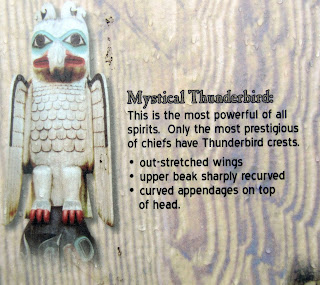
Pole 14:  Thunderers
Because of the sunlight, I couldn't get good pictures of all of the poles.

Behind the gift shop on an adjacent property, there was  Potlatch Park Carving Center.  The carvers' were not there, but I could see their work in progress.
carvers' work area

There were some unusual bushes growing along the pathway that were filled with white flowers that looked a bit like strawberry flowers.  I asked and found out that these were salmon berries.  I later tasted a jam made from these berries and it was pretty tasteless (except for the sugar) but the natives used them for many things.
From what I read, they more closely resemble raspberries.


My poncho kept me pretty dry…just got wet feet.

I got back on the boat, picked up my laptop and headed out again to the library a few blocks away and got a pass to use the internet for free for a dollar.  They asked for a donation to help remodel the library, so I happily complied. 

Ketchikan, Alaska, Part 1 June, 2012


I AM ON VACATION!  The mantra continues.  The ship docked in Ketchikan at a little after 7 a.m.  We were at sea yesterday, and the weather was lovely.  Today would be different. 

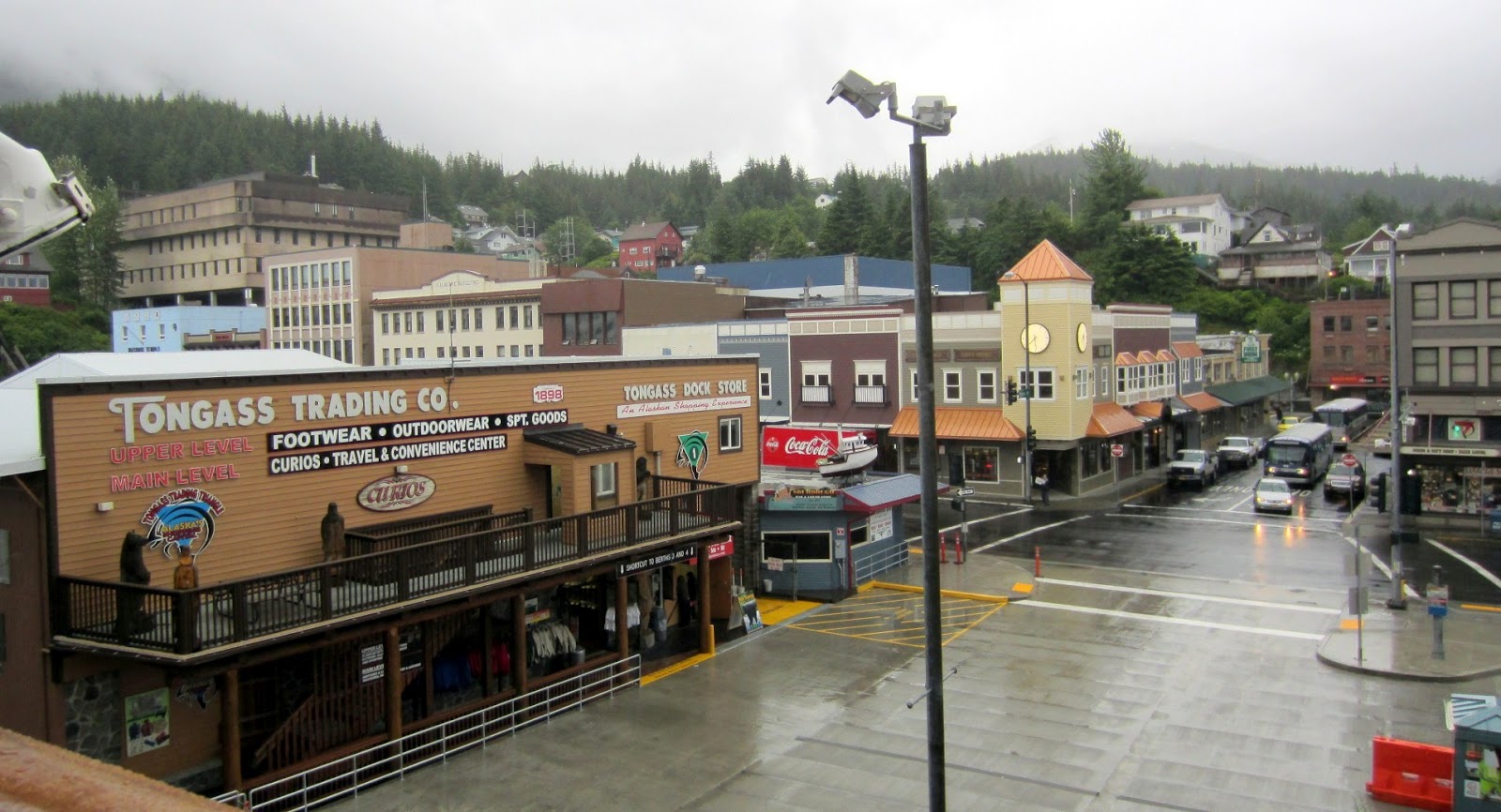
The town looks very quaint from the dock.  After about 3 blocks in, it became hilly.   It is long along the coastline and narrow otherwise.

I went into town at about 9, wearing my green poncho as there was a steady rain.   The ship docked right in the center of the western part of town. 

  After stopping at the information center when I got a walking tour fold out map, I found where to get the free shuttle up to the hatchery and eagle center and the totem heritage center.   I had printed out a similar map off of the website for Ketchikan.   Ten minutes later, I got off the shuttle and for $15, got into the two centers.   

Ourside the Totem Museum


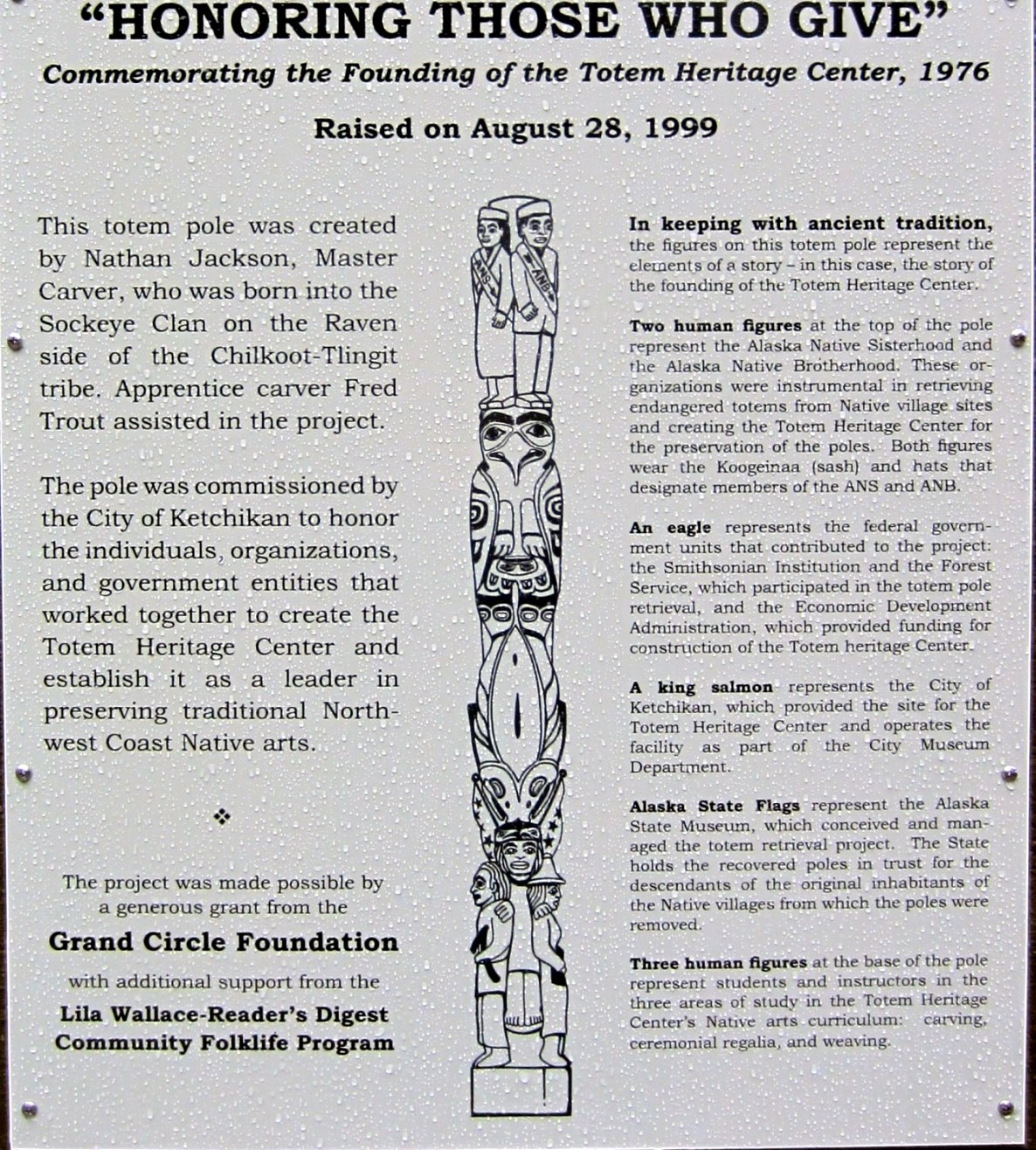
 Above:  Totem created for the creation of this center.  

When I walked in, I faced 3 huge totems.
Totem poles honor the dead, record history and oral tradition.  They were never worshiped.  Once raised, they were left to deteriorate naturally.  The western red cedar were often used to make poles as they withstood the damp climate quite well.  The above examples were carved in the mid- to late-19th century.  They were brought to Totem Heritage Center in 1976 to provide examples of traditional carvings and to inspire future carvers.

This is a close up of pole #3 above.  After missionaries came to the area, people used to make poles that honored the dead.  The top figure on this pole is brown bear, with wide nostrils, strong teeth, and sharp claws.

Tlingits in Tongass Village in 1868 with US Federal agent.  .  This was one of the first photos taken in Alaska.

Tlignet in traditional regalia
During the Depression, carvers at Saxman Village kept the art of carving going.
In the above photo taken at Saxman Village in 1941, a group of Native carvers work on the Wandering Raven pole, which now stands in the entrance to the Clan House in Totem Bight park.  This was one of many totem poles carved as part of a Civilian Conservation Corps project in the late 1930s and early 1940s.

The following describes some of the reasons of totem poles  were carved historically:
Above is a picture of Chief Johnson's house and totem pole in 1904.

Above is the interior of Chief Lots' house in 1898.

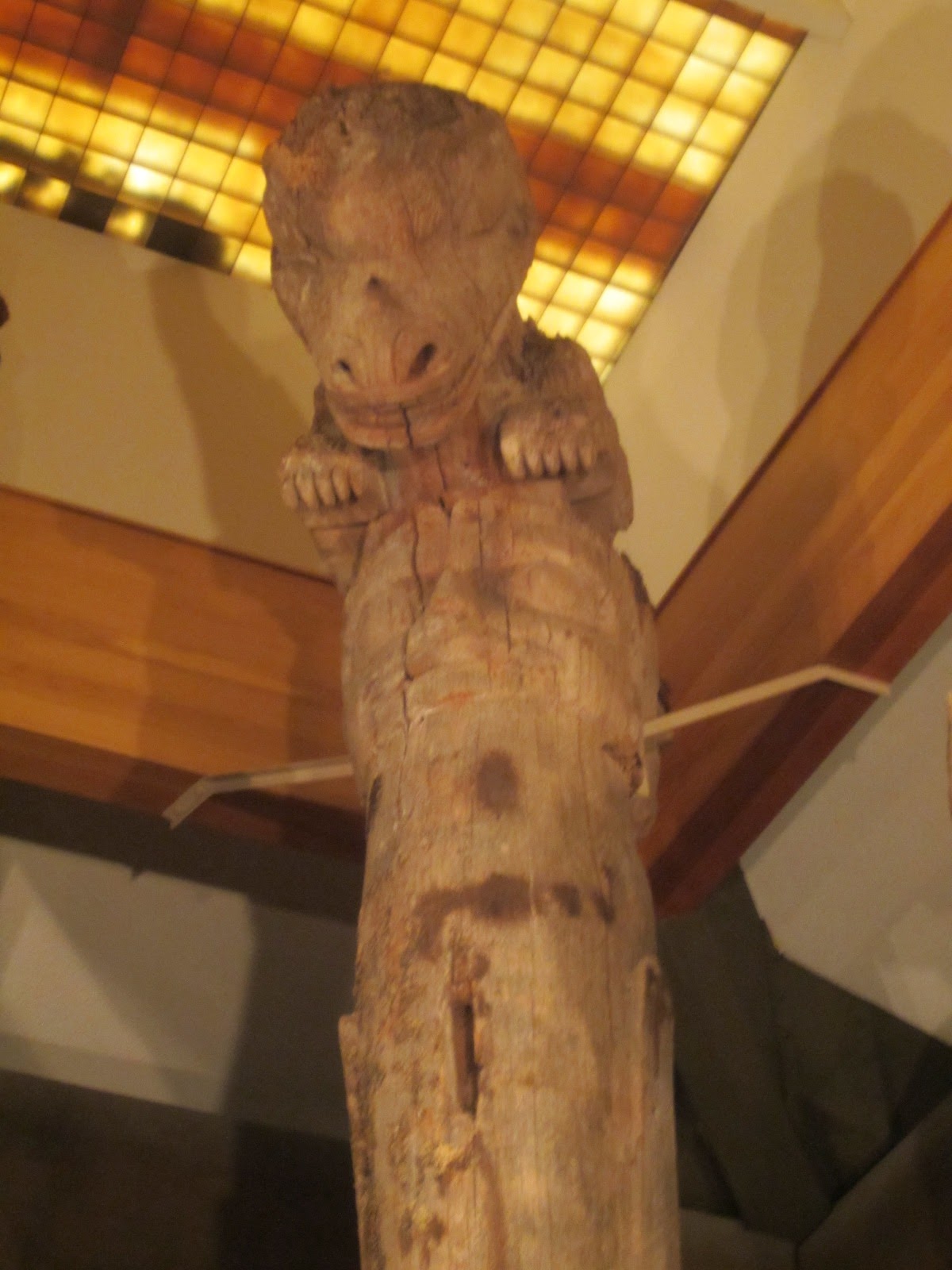
Head of an old pole lying sideways in the museum.
The Raven figure above originally topped a 50-foot pole that stood in the center of a village.  There are elements of a frog crest on the raven's breast and the tail may represent a sea mammal.  You can see the original pole above in black and white.  
Totem poles often had rings on them.  They symbolize the number of generations an object or story has been owned by a particular group.
Poles were often used as supports for homes.  Here is one that looks like an inverted eagle's claw. It is one of four that supported the main beams in a house in Old Kasaan.
There were also masks on display, made by instructors in the Totem Heritage Center carving classes. 

Masks served a number of functions. The animals, humans, and mythical figures they depict may represent important events or feats or symbolize stories of clans or individuals.  During special occasions, the masks are brought out and the stories are repeated so that they will be passed on.   In some places, masks are made for a specific event and they thrown away.

I then went to the bird sanctuary and fish hatchery.
From 1917 to 1953, there was a bounty on bald eagles as the fish farmers through the eagles were raiding fish from their ponds.  Eventually, they found out that was not true, but a # of eagles had already been killed.  Juneau has a raptor recovery center.  If an eagle loses a feather on one wing, one on the other side automatically falls off.  
The sanctuary has an owl and 3 eagles that cannot be released in the wild.  There are a number of such sanctuaries throughout Alaska.  Two of the eagles cannot fly at all so we could see them.  Auroro, the eagle on the left below,  was found on a garbage dump with  her left wing badly broken.  She weighs ten lb.  Cha-ak on the right hit a power line in Anchorage.She weighs 13 pl.  These birds are powerful and can exert 1000 lb. of pressure per talon.  Bald Eagles have a wing span of 6 to 8 feet.
 The 2 eagles built the next above with twigs supplied by the staff.  The grey horned owl was shot by a hunter.  It has shrapnel in its right wing.  The owls are the least intelligent of girls of prey as their eyes take up 90% of their brains.  These eagles lay 2 to 3 eggs in the beginning of May and sit on them for about 30 days, which is the usual incubation period.  Then the staff take away the eggs.
Eagles have amazing eyesight but have to rotate their head to see to the sides.


We then saw the fish hatchery and heard about the different kinds of salmon.
Later I learned the names of the 5 kinds through a finger association:
Thumb = Chum
Point (to eye) = Sockeye
Tall finger = King
Ring Finger = Silver
Pinky    =  Pink

The salmon imprint on the water in Ketchikan creek so return to the hatchery.  From 30 they take the eggs and use them for the new spawning.   Below you can see the development of the eggs.  They are 6 months in incubators and are these coho and king salmon are released into the creek when the salmon are a year and a half old. 

The rest they release back into the stream to lay their eggs naturally.  They give the 30 mentioned above to low-income area people or feed them to their birds.

I then walked down the Creek Street boardwalk.


 It paralleled Ketchikan Creek and had stunning views as I walked along.  I took off my cape hat briefly for this picture even though it was still raining fairly hard..
 I saw a number of beautiful (big) rhododendron plants along the way, about 6 or 7 weeks after these plants flowered in Seattle.

 Many of the houses along the creek had been bordellos and bars when the logging and mining industries boomed but since then (esp in the past 20+ years) most have become businesses, art shops, or (especially) tourist places.

  I stopped at the Star house, also called Dolly’s house.  It is a slightly upscale tourist place with the original star in the floor still preserved.

Part two of Ketchikan will follow with a description of the town museum, library, and Totem Bight state park, where I saw a lot of totem poles.