On February 2nd, we gathered together to get to know our fellow tra,velers and for dinner. We have an amazing group. In my last email, I mentioned the director of MayaWorks Jeannie Balanda, and the founder and volunteer coordinator of Fair Trade Judaica, Ilana Schatz, and her husband David Lingren. I also talked about the three from Philadelphia, Betsy, Helen, and Mindy, whom I had an adventure with earlier that day.
Others on the trip included Marcy Bernbaum, my daughter-in-law's mom. Marcy worked for USAID for many years in education and helped set up the bilingual education program (native language plus Spanish) in Guatemala. She is my "consuegra," a word that doesn't exist in English. Her sister-in-law, Diane Bernbaum, also is on the trip, and she recently retired as head of the Berkeley Midrasha supplemental Jewish high school. She also has traveled a lot, including to Nepal, with her husband Ed, an expert on that country. We were delighted to have Danny Siegel, the Mitzvah man of the Conservative movement, with us. He first introduced me to Maya Works via Ziv Tzedakkah fund about 16 years ago. In 2001, bought some of their kippot (which were a bit flat as the women were learning how to make them--they are amazing now) and hoped some day to meet the women who made them. Susan Bernstein is a Jewish educator and administrator from Florida, and we knew each other when she lived in Seattle. Joy M. and Pamela Z. are sisters, and Pamela is the president of her Reform synagogue in MA. The two of them as well as Diane, Betsy, and Mindy are handicraft artists.
After a delicious breakfast the next morning, including a plate of smiling papaya and watermelon and homemade tortillas,


we left at 8 a.m. for a long day on the road and visits to some amazing women. Fidencio, our guide, was a treasure. As we drove, Fidencio gave us an introduction to the area. He told us there were originally 33 languages in the area, but ten groups were destroyed in battles with the Spanish. Twenty three remain, of which 21 are Mayan languages. K'iche' is the largest and spoken by about a million people. Kaqchikel is spoken by about 800,000 people.
The following is from Wikipedia, from data in 2003.
| language | Family | branch | maternal Speakers | Notes |
|---|---|---|---|---|
| Spanish | Indo-European | Romance | 9.481.907 | Although Spanish is the official language, it is not spoken by the entire population, or else is used as a second language. There are twenty-four distinct indigenous languages spoken in Guatemala. |
| K’iche’ | Mayan | Kiche' | 1,000,000 | Language spoken in six departments: in five municipalities ofSololá, Totonicapán, Quetzaltenango, El Quiché,Suchitepéquez and Retalhuleu. Spoken by 11.31% of the population.[2] |
| Q'eqchi' | Mayan | Kiche' | 555,461 | Spoken in Alta Verapaz, El Petén, Izabal and in El Quiché. It is spoken by 7.58% of the population.[3] |
| Kaqchikel | Mayan | Kiche' | 500,000 | Spoken in six departments: Guatemala, Chimaltenango, Escuintla, Suchitepéquez, Baja Verapaz and Sololá. It is spoken by 7.41% of the population.[3] |
| Mam | Mayan | Mam | 480,000 | Spoken in three departments: Quetzaltenango, San Marcos, and Huehuetenango. Spoken by 5.49% of the population of Guatemala.[3] |
| Poqomchi | Mayan | Kiche' | 92,000 | Spoken in Baja Verapaz and in Alta Verapaz. Spoken by 1.02% of the population.[3] |
| Tz’utujil | Mayan | Kiche' | 88,300 | Spoken in two departments: Sololá y Suchitepéquez. It is only spoken by 0.7% of the population.[3] |
| Achí | Mayan | Kiche' | 85,552 | Spoken in five municipalities of Baja Verapaz. Only spoken by 0.94% of the population.[3] |
| Q’anjob’al | Mayan | Q'anjob'al | 77,700 | Spoken in four municipalities of the Huehuetenango department, by 1.42% of the population of Guatemala.[3] |
| Ixil | Mayan | Mam | 70,000 | Spoken in three municipalities of the El Quiché department, also known as the Ixil Triangle: Santa María Nebaj, San Gaspar Chajul, and San Juan Cotzal. Ixil is spoken by 0.85% of the Guatemalan population.[3] |
| Akatek | Mayan | Q'anjob'al | 48,500 | Spoken in two municipalities in Huehuetenango: San Miguel Acatán y San Rafael La Independencia, by 0.35% of the population of Guatemala.[3] |
| Popti (Jakalteko) | Mayan | Q'anjob'al | 40,000 | Spoken in Huehuetenango, by 0.42% of the population of the country.[3] |
| Chuj | Mayan | Q'anjob'al | 40,000 | Spoken in three municipalities of Huehuetenango, by 0.57% of the population of Guatemala.[3] |
| Poqomam | Mayan | Kiche' | 30,000 | Spoken in Guatemala, Jalapa, and Escuintla. Spoken only by 0.37% of the population.[3] |
| Ch'orti' | Mayan | Chol | 30,000 | Spoken in two municipalities of the Chiquimula department (Jocotán y Camotán). Also spoken in a part of the La Uniónmunicipality in Zacapa. Spoken by 0.42% of the population of Guatemala.[3] |
| Awakatek | Mayan | Mam | 18,000 | Primarily spoken in the municipality of Aguacatán in the Huehuetenango department. Spoken by 0.10% of the population of Guatemala.[3] |
| Sakapultek | Mayan | Kiche' | 9,763 | Spoken in the municipality of Sacapulas in El Quiché. Only spoken by 0.09% of the population.[3] |
| Sipakapa | Mayan | Kiche' | 8,000 | Only spoken in the Sipacapa municipality in the department ofSan Marcos. |
| Garífuna | Arawakan | Caribeña | 5,860 | A non-Mayan-derived language, this language, unique to the inhabitants of Izabal, is one of the languages imported into Guatemala via the black slaves Spanish colonists brought from other places. Spoken by 0.04% of the population of Guatemala.[3] |
| Uspantek | Mayan | Kiche' | 3,000 | Spoken in the municipalities of Uspantán and Chicamán in the El Quiché department. Spoken only by 0.07% of the population.[3] |
| Tektitek | Mayan | Mam | 2,265 | Spoken in the municipality of Tectitán in Huehuetenango, by 0.02% of the population of Guatemala.[3] |
| Mopan | Mayan | Yucateca | 2,000 | Spoken in El Petén, by 0.03% of the population of Guatemala.[3] |
| Xincan languages | Isolate | Xinca languages | 16 | A language not derived from Mayan with unclear origins. Some hypotheses suggest that the Xincan languages may have arrived from the South. Xinca is spoken by only about two hundred people in the Santa Rosa and Jutiapa departments, and is currently an endangered language, spoken by 0.14% of the population of Guatemala.[3] |
| Itza | Mayan | Yucateca | 12 | Spoken in six municipalities of the El Petén department, by 0.02% of the population of Guatemala |
As we rode along, we saw signs on businesses with Jewish sounding names in the title, such as Tienda Shaddai, Tornos Sinai, Servicios Shalom, etc. We were told they probably belonged to Evangelicals, who comprise 40% of the Guatemalan population. The one below I saw in Antigua. I went in and asked how the name was chosen, and the young woman said that the owner had a good friend who was Israeli.

Corn is the staple of the Mayan diet, with four kinds of corn grown: yellow, white, red and black/blue. It is highly nutritious and homemade ones are delicious!!!! I am not sure I can eat store bought ones ever again! Corn is the basis of the diet of the very poor--tortillas with salt and chiles. Fidencio said that people of Mayan decent do not have enzymes to digest wheat, so they eat very little bread. The people often have gardens. They grow corn in the rainy season, and then beans grow up on the dried stalks in the dry season. They then sell the beans, and if they have extra, they eat the beans too.
This day we traveled at altitudes ranging from 6000 to 7500 feet, where pine, cyprus, and oak trees dotted the landscape. We drove through small towns with narrow streets, and at one point the road was too narrow and a bit too crowded to turn onto, so our terrific driver backed up a block to get out of this quandary!
Many of the buildings in smaller towns were painted in vibrant colors.

We entered the city of San Juan Comalapa (population 35,000) in the province of Chimaltenango,, and the outside of the walls of the town cemetery had amazing murals. This project began in 2007. The townspeople suffered greatly by the civil war from 1960 to 1996. The military post on the edge of town committed thousands of crimes against the local indigenous peoples. The murals depict the major events in the history of Guatemala, including the Maya creation story, the Spanish conquest, daily life, and the civil war. The murals were painted by a collaboration of local artists.


The town is known for its artists, especially for Andres Curuchich for his paintings of local village life. His works have been displayed in galleries as far away as New York. There are over 500 artists who live here, and many continue with Curuchiche's artistic style.
Ester Nohemi Miza Curruchichi, age 33, is an activist and advocate for indigenous culture . She is responsible for the upkeep of these pictures, the longest set of murals in Guatemala.


We were heading to the tallit weavers of Comalapa and challah cover weavers in Agua Caliente. We stopped along the way at an elementary school where many of these weavers' children study.

There are 271 students in grades K-6, from ages 6 to 15. Some children stop school to help at home and then return, so that is why some are older. They go to schools five days a week from 7:30 to 12:30. They all walk to school and most have to walk at least 30 minutes each way. The school year is from mid-January through October. Most of the harvesting is from November through January, so during vacation, children help wit the harvest. 90% of the children in this area go to school. During the rainy season, however, the roads often flood so it is too dangerous for the children to walk to school.
Below are two pictures showing Danny Siegel showing the children pictures of them that were taken on his last visit to the school a year ago on a tour with MayaWorks. They were so excited to see him and the pictures that they were in! They all seemed very happy and serious about being in school. We all loved their smile and enthusiasm.


Eight years ago, the government provided breakfast for children in the six poorest regions in the country in hopes to keep children in school, but many did not attend and helped their parents. So the government added a free lunch. Still many did not come. Then the government paid families $40 a month for the children to stay in school, and they did! As result, a million finished vocational high school, but unfortunately there were not enough jobs for them.
Eighteen girls at the school, mostly children of MayaWorks weavers, receive scholarships from MayaWorks, as one of the organization's goals is to keep girls in school. The girls on scholarship also get extra tutoring help and enrichment programs after school.
There are some workshops offered for parents and literacy classes for them too, sponsored by Maya-Works. Some of the women wanted to learn Spanish. They set a goal of 80% of the women to be at a 6th grade reading level by 2015, and they succeeded!!
In the picture above is a green building in the background. At the advice of the school, MayaWorks provided funds for a kitchen in that building. Until this year, mothers used to cook a high protein breakfast and snack for the children, so they would be more alert in school. The government provided funds for the food, but stopped doing so about a half year ago. The school director hopes that with the new government, the funds will soon resume.
 |
| The stove in the kitchen, fueled by fire wood |

Most of the girls wore traditional clothes, huipiles (blouses) made with love by their mothers and cortes (skirts) woven by their mothers too. Boys tend to wear T-shirts and pants, as they are a lot less expensive to buy. Women in the country tend to wear traditional clothing much more than men.
Most of the children are tiny and look at least 2-3 years younger than they actually are.
My little stuffed doggie Maya (wearing a kippah) was a hit with the children!


The children enjoyed playing with Joy and Pamela .


Marcy enjoyed talking with them. The girl below on the left is 15, I believe.

Juana, one of the young girls at the school, lived across the street from school and invited us to visit her there. She is an orphan, and she and her two brothers live with her aunt Santa Silvestre in the family compound. I don't think the aunt spoke much Spanish. Often one family lives per room in such a compound. Juana also receives a scholarship from MayaWorks to attend school.
 |
| A house next to Juana's aunt's home. |
 |
| The family coffee tree |
 |
| Juana holding a kitten |
 |
| Juana's aunt is to the left in the background |

The women introduced themselves and then we introduced ourselves.
 |
| Natalia on the left |
Maria Arcadia also has been in the group since the beginning 20 years ago. She has four children and six grandchildren.

Christina was shy and talked in Kacheket. She has five children and one grandson.

The red bands on the arms of the huipil above shows that the huipil is from Comolapa.
Huipiles here often have flowers on them as flowers bloom a lot in this region. Many of the designs are so old that the artisans do not know the origins of the designs.
Each woman makes her own huipil and has four to six for personal use, which can take up to a half year to make. One woman in the group only had two. They often last for ten years or more.
Maria Concepcion, Natalia's daughter, is 40. She is a widow and has seven children, and was very proud to tell us that all of them are studying.
Eufemia also started 20 years ago with MayaWorks but for a while worked in the capital. She too is Natalia's daughter. She has three daughters, one a nun in Spain and two grandchildren. Her oldest daughter is studying social work in college.
Ten of the girls from the village have gone to Spain as nuns.
 |
| Family visitors |

This group makes shawls, table runners, and tallitot. They do not sew. Note the shawls for sale, etc. behind our group. We all loved the bright colors and the quality of the work that they do. It was also wonderful to see this multi-generational group and the love and respect they show each other.

The two men below are members of the local staff of MayaWorks. Carlos "Charlie" is in administration and works mostly in the office in Chimaltenango, and Luis Angels is the bookkeeper. He is married with a two-year-old daughter. Angelica is 22 and is a translator, is in charge of quality control, and is the production coordinator. She was a MayaWorks scholarship recipient in the past. Her mother is an artisan in another group. We were delighted to hear that Angelica got engaged a week ago and will marry in the spring.


Weavers are not respected in the country, so the women want their children, especially their daughters, to find work in the formal sector, so they can be more successful. The women weave their own blouses called huipiles, and they take them four to six months to make. Women weave at home, around their other home responsibilities. Over 700,000 women in Guatemala weave, so in a small community they may not have much of a market. This group has really benefited by having the link with Maya Works and making specialized products that are sold at a good price outside the country, and we were delighted to be a part of a group that has helped this women market their excellent products.
MayaWorks also gives Micro Credit loans and training courses. The loans average $500. They do not fund the whole project, so the women must contribute some of the funding. Last year a corn crop was funded, and the woman paid off the loan and had enough to grow a crop of cabbages too. Others have borrowed money for a new loom, for crops, for a lumber yard in a home,and for natural cleaning products sales..
We had a delicious lunch made by the women of rice, beans, potatoes, avocado, tortillas, tamales and sweet plantains for dessert.

 |
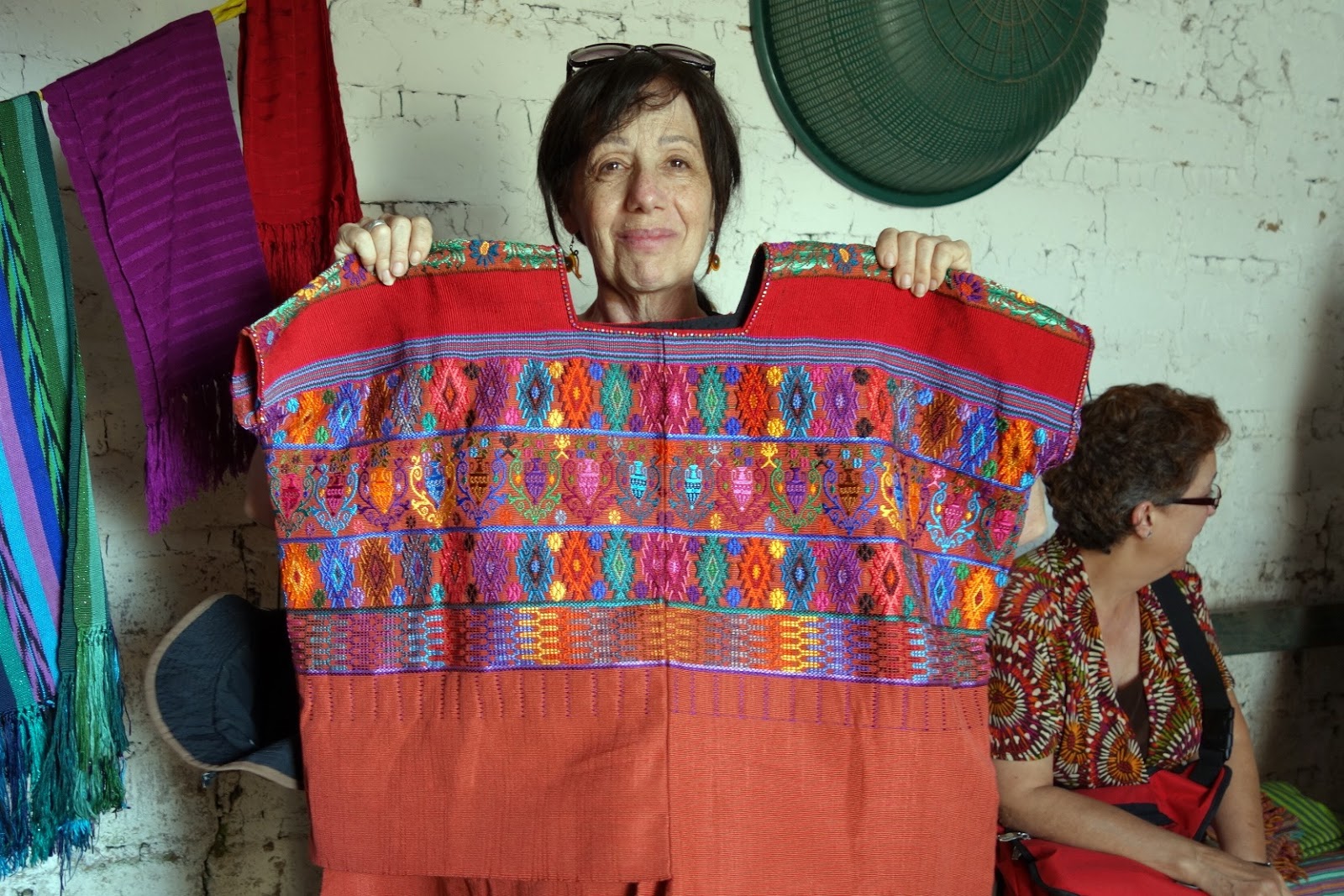
| A beautiful shawl made by the woman holding it. Maya doggie with kippah was resting in my fanny pack |
 |
| A photo of all of us together |
Jeannie and Ilana first met up six years ago and have been brainstorming ideas ever since. One result was the first fair trade tallitot.
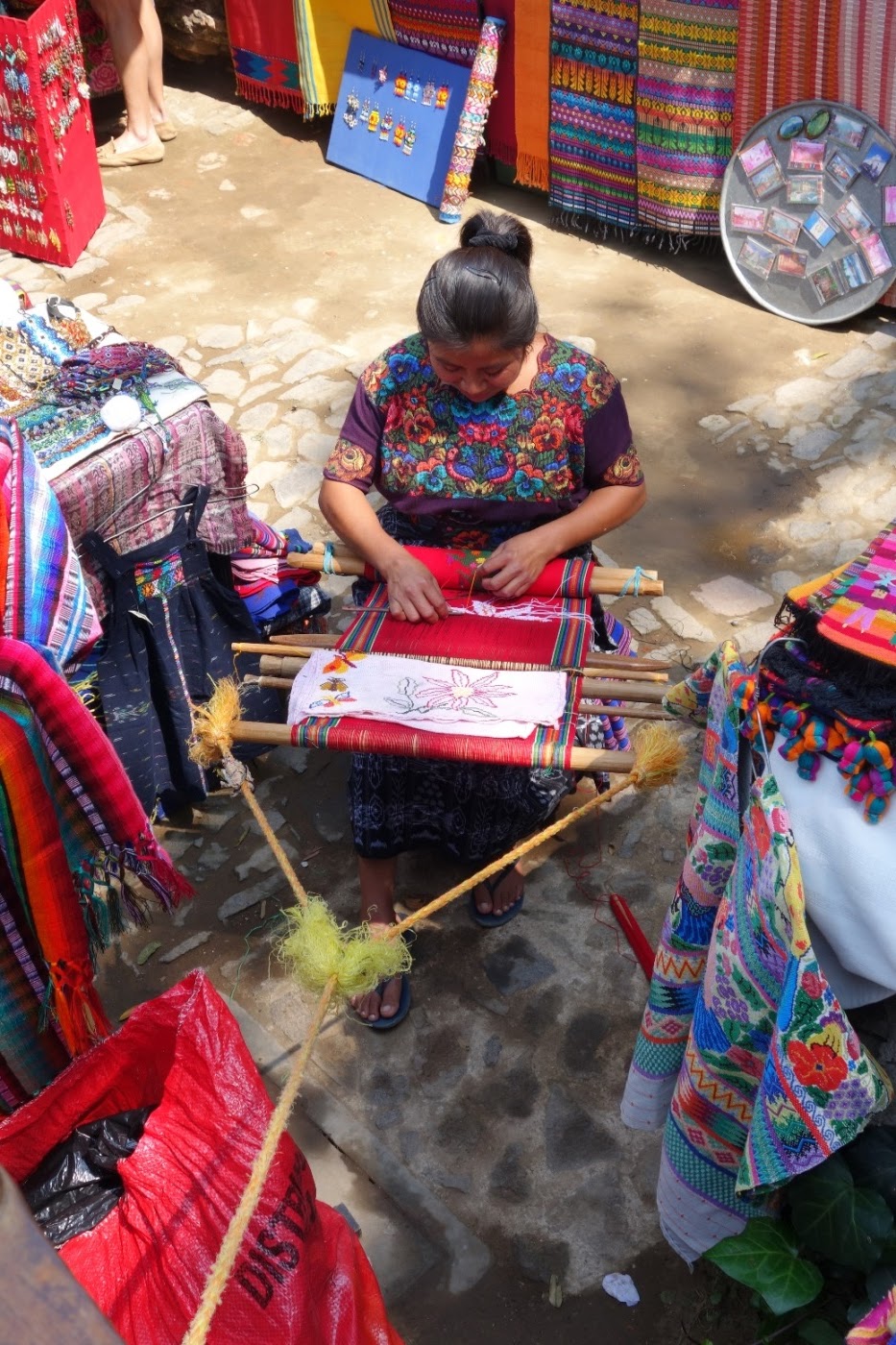
We then went to Lila's home. She is part of the Tzanjuyu (pronounced San-who-you) group of eight highly skilled women. who make place mats, scarves, bags, bibs, and tallitot. While other groups can only make shorter tallitot, Lila can make 36" ones also. She has made over 175 tallitot and has trained seven other women to be her back ups. She buys material in thread shops and uses a back strap loom and foot loom treadle. She recently built a place on her roof for her treadle loom and her workshop. She built it with extra funds that she has earned as a result of selling her products through fair trade groups. Lila is an amazing woman--both in the quality and quantity of art work that she produces and as a strong woman and role model for other women in the area.
Below Ilana is showing us her tallit. It was the first tallit that Lila wove and was given to Ilana as a sample. Ilana tied and put her own tzitzit on her tallit and then took the tallit to Judaica stores to show them the lovely work and to see if they were interested in purchasing them.
Below Ilana is showing us her tallit. It was the first tallit that Lila wove and was given to Ilana as a sample. Ilana tied and put her own tzitzit on her tallit and then took the tallit to Judaica stores to show them the lovely work and to see if they were interested in purchasing them.
 |

 |
| Adjusting the backstrap loom |
 |
| Kneeling and working on the backstrap loom |
We walked up stairs to see Lila's treadle loom and also saw corn drying on her roof, to later be ground for making delicious tortillas.

Lila demonstrated how she worked on her larger loom.


And again we shopped. I bought a tallit like Ilana's, probably for my grandson. It did not have the tzitzit on it yet (they are usually tied on in the US for Maya Works) but whoever gets the tallit will have the pleasure of tying them.
 |
| Lila and I with the tallit she made
In addition to the tallit, I bought three scarves, one of which could easily be made into a delicate tallit and others bought some beautiful things.
As we were leaving, we saw this DLight unit on the wall. It is a solar charging lantern that provides many hours of good LED light. It replaces kerosene lamps. Betsy provided me with that information and thought that Lila had electric lights, but the grid can be very balky and unreliable, and likely expensive. So LED solar lamps provide great back up, or even alternative replacement lighting.
  |
That night we stayed in a cute, somewhat quirky hotel called Albergues de Tecpan. Plastic soda and water bottles were recycled to make walls, doors, and planters. Betsy had made me much more aware of the possible uses of used plastic bottles, so I kept an eye out for them and was delighted to see them used here.


 |
| Close up of door |

The next blog will tell about our visit to Mayan Hands basket weavers,a visit to butterfly weaving in San Antonio Aguas Calientes, the town known to have the best weavers in the country, and a visit to the Ixchel Museum of Indigenous Clothing.